 |
| Nice Attribution!
Theodore W. Frick, professor emeritus in the Department of Instructional Systems Technology at Indiana University Bloomington, is a alongside Edward Castrova - Exodus to the Virtual Worlds - & Lee Sheldon - The Multiplayer Classroom - who has a working relationship with Jesse Schell, Earthbound VR God - The Art of Game Design - at Carnegie-Mellon Entertainment Technology Center. Nice.
A bunch of educational technology superheros, these guys.
Dr. Frick lays out a model for which credits a wonderful teacher & educational philosopher, Elizabeth Steiner. The model puts in clear terms the four crucial elements (and their respective relationships) of the educational system: Teacher, Learner, Context, Content. The balanced interaction of those essentials creates harmony & equilibrium in educational systems. This model might be visualized so: 
An analysis of the way things are vis-a-vis each other, for example, Teacher-Learner Relationships or Learner-Context Relationships follows. Then, prophetically, Dr. Frick sets up a series of "what ifs" that might occur in the best of all possible educational worlds. Below, I've attached screenshots of Fricks brilliant & foresightful fastback.
Teacher-Learner Relationships
 Learner-Content Relationships  Teacher-Content Relationships  Learner-Context Relationships 
Teacher-Context Relationships

Content-Context Relationships

Educational System-Environment Relationships
 Many of the "what ifs" have come true. The ones that have not have an infrastructure of technology in-place to manifest themselves. I believe it is only a matter of time. Bravo Dr. Frick, keep pushing the envelope - for you know better than most of us that the future is not really predicted . . . it's created by visionaries who can see a whole forest while the many of us only see the acorn as food for squirrels. Cheers! |
Wednesday, November 30, 2016
I'm Crazy about Frick!
Today, I'd like to talk about Frick - Professor Theodore W. Frick - and his brilliantly prophetic fastback. What's a fastback, by the way?! Dr. Frick is definitely moving faster than a Mach 1!

Sunday, November 27, 2016
Thursday, November 24, 2016
Monday, November 21, 2016
I'll take the glass that's half full, please.
Discussion of Integrating Computers in the Schools
As we read this article, there are a lot of concerns that are raised about integrating technology into our classrooms. What are the biggest factors that inhibit technology integration in your experience in classrooms?
Alright then. Please bear with me for a minute.
As we read this article, there are a lot of concerns that are raised about integrating technology into our classrooms. What are the biggest factors that inhibit technology integration in your experience in classrooms?
Alright then. Please bear with me for a minute.
I am the starry-eyed optimist, the wild-haired crazy one who drinks way too much coffee, always saying "Trust me, it'll work," often wrong but not always. I'm not sure if you all have heard of Larry Ellison of Oracle or Elon Musk of SpaceX and Tesla. You know who Google is even if you've never heard of Larry Page. And hopefully, you've heard of Steve Jobs of Apple. This is one of the cool things Apple had to say about visionaries:
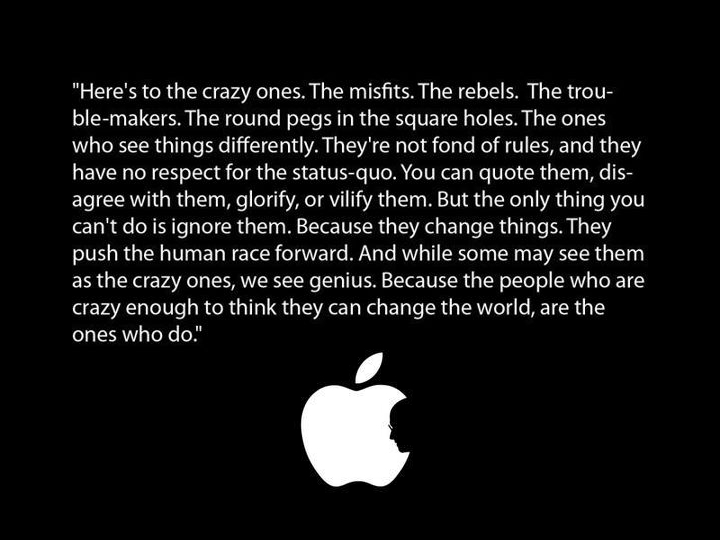
This league of extraordinary gentlemen (thought to be crazy by their contemporaries) sees a future of unbounded potential - exponential learning, sharing and information exchange that will make what's happened since the Dawning of the Internet look like a church house school room from The Little House on the Prairie. I'm only carrying their message . . . yes, possibly as a duped aficionado.
So, I'm not really going respond otherwise to the criticisms of using technology in the classrooms. Oh, I acknowledge them. I'm aware of them, not just theoretically but as one who is on the other side. I pioneer the use of technology in the classroom, at my own expense - financially & temporally - quite often. I've read the book Teachers & Machines by Larry Cuban, recommended by our good Doctor, as well as many other book-length criticisms of over-sold technology and the damage that the Information Age will cause our children. Some good one's include Howard Gardner's App Generation and Sherry Turkle's Alone Together. Very good reads all and understandably cautionary.
I am not a snake-oil huckster or corporate charlatan. I am someone who can see an unstoppable wave that is coming. Or, as economist Edward Castronova has called a "teacup in a hurricane" in his his cool-headed analysis of the future Exodus to the Virtual World. So, I choose to look forward to the bright Future not lament the unchangeable Past.
I will say this, as the most common observation (tech historians and tech advocates) of why seminal technology is not integrated, teachers are resisting technology in the classroom.

With all that said, I love the fun of the scholarly debate and philosophical discussions of whether or not we should do something simply because we can. And, if only for the fun of it, I'll always play the Devil's . . . I mean technology's advocate. And of course, the Borg were defeated, LOL!
Thanks for humoring a trusting, naive philosopher. Cheers!
Wednesday, November 2, 2016
Chalkboards & Sexy English
I'll take the first question as it will help folks to understand me better - as I feel I've misrepresented myself with my Virtual Zeal.
I began teaching English in suburban China in 2006.
Classrooms where as has existed since the first part of the Twentieth Century. The smartest part of the classrooms were the colored chalk - red, yellow & blue. I preferred to use white, though, as I general wore dress shirts to class. The combination of no air-conditioning & colored chalk, I discovered early on, led to a rainbow-tinted silt on my shoulders after four or five hours of black board scribbling & the concomitant erasures. Good times!
I loved using the chalk boards to elucidate language with Pictionary & Win, Lose or Draw vocabulary lessons. More good times. I didn't reach a school with a smartboard until my fourth year in China. And, I was resistant to change. I had no idea how to use a smart board. If someone asked, "Hey Bai Lao Shi . . . why no use computer?" I'd huskily retort, "All I need is a group of Chinese minds & a sexy subject to create English conversation."
And that is still very true.
I prefer to simply engage groups of English-as-a-Second Language (ESL) learners in Socratic Seminars. The topics are endless & I don't believe we'll ever need media to teach language. The media (our voices) & method (interesting inter-locution) that has existed for language learning these thousands of years is quite sufficient & necessary to create meaning.
I've only become an EdTech Strategist as I have found that it has far more appeal to youth. Appeal is not necessary for language learning. But, it enhances it greatly. As there are so many wonderful & appealing digital flash card apps (Quizlet), speech-to-text capabilities (Merriam-Webster powered by Google) & tablet top quizzing platforms (Socrative) . . . well, I'm a kid in a digital eye-candy store.
Digital media is not necessary to learn language, or anything else that was taught before the brilliant dawning of the Information Age. But it really is a good time. And I want to know & use every sexy novelty that comes along. After all, we are here for a good time, aren't we? Yes, I think I read that somewhere.
Thanks for your patience with my loony crooning about tech, ya'll.
Cheers,
Ry
Subscribe to:
Posts (Atom)