Tuesday, December 27, 2016

Wednesday, December 14, 2016
Jesse Schell's VR Predictions
Oh wow! Listen to these predictions - and remember, industry experts predict by manifesting.
Here's the SlideShare:
Here's the SlideShare:
Tuesday, December 13, 2016
Thursday, December 8, 2016
Wednesday, December 7, 2016
All is Well that Ends Well!
What a brilliant end to a brilliant class - and a equally great send off by the good Doctor Monson. Thank you, my Friend.
It was good to see that most other Project Teams described their intra-team workings and communications. For example, that Katie, Jared, and Grant kept each other honest to deadlines using Slack was a good reminder. I'd used the Slack app on my Xperia tablet in the past to build a start up with my brother and will make certain to set that down for team projects in the coming semesters.
I found it striking that our team had no group introspective analysis to speak about on the final presentation. Nor did we speak about what we learned from working within our group - 3J1R. Perhaps we . . . no, I was a little too obsessed with what VR could do to notice the intra-workings of our team. We used the GroupMe app to coordinate our efforts. Valuable asset.
One thing I missed from my previous masters degree team projects was meeting with the groups outside of class. This was hampered a bit by proximity and that I was located in Ogden, Utah, while the rest of my teammates were located in Salt Lake City, Utah. John and I met at his place of creation - YouthCity at Liberty Park - a few times. These were valuable interactions for us and the testing of our VR ideas on his students. We did have several weekend Skypes.
One thing that I'd like for my future teams to use in collaborative meetings and online interactions is Altspace. Altspace is a virtual space in which users can chat and interact with each other's virtual avatars.
It was good to see that most other Project Teams described their intra-team workings and communications. For example, that Katie, Jared, and Grant kept each other honest to deadlines using Slack was a good reminder. I'd used the Slack app on my Xperia tablet in the past to build a start up with my brother and will make certain to set that down for team projects in the coming semesters.
I found it striking that our team had no group introspective analysis to speak about on the final presentation. Nor did we speak about what we learned from working within our group - 3J1R. Perhaps we . . . no, I was a little too obsessed with what VR could do to notice the intra-workings of our team. We used the GroupMe app to coordinate our efforts. Valuable asset.
One thing I missed from my previous masters degree team projects was meeting with the groups outside of class. This was hampered a bit by proximity and that I was located in Ogden, Utah, while the rest of my teammates were located in Salt Lake City, Utah. John and I met at his place of creation - YouthCity at Liberty Park - a few times. These were valuable interactions for us and the testing of our VR ideas on his students. We did have several weekend Skypes.
One thing that I'd like for my future teams to use in collaborative meetings and online interactions is Altspace. Altspace is a virtual space in which users can chat and interact with each other's virtual avatars.
 |
| Nice avatar!
Yessss, innovator platform for collaboration . . . this is.

Innovator leads to early adopter. Early adopter lead to majorities and on to mainstreaming. Yessssss! Thank you Dr. Everett Rogers! In his brilliantly insightful look at how humans receive new technology, historically, the Diffusion of Innovations bell curves the population and gives them apropos labels. Pfff! Lagards!

And in order for us to see the tools of collaboration continue to evolve, we must push them. There is no predicting the future - only making it manifest. Remember your Frick! This is my goal with EdTech. I'm gonna say, "VR, VR, VR, VR, VR, VR, VR, VR, VR, VR . . ." ad nauseum until you all go buy one or stick a bicycle spoke in my eye.

Last but not least in this humble entry, I love the camaraderie and rapport that has developed with our entire cohort. It's got a real family, or at least, youth conference-type bonding feel. I'm happy to see that we've got such a diverse group - public and private school teachers, industry designers, exchange students (Yay, Xi Pei!), and even a professional student and philosopher, in the mix ;).
I really look forward to the coming semester of Human Computer Interaction and Multimedia Learning!
Thanks again, Dr. Monson for creating a fun-loving, clever, Star Wars enthusiastic & diverse forum!
See ya next year, Y'all
|
Wednesday, November 30, 2016
I'm Crazy about Frick!
Today, I'd like to talk about Frick - Professor Theodore W. Frick - and his brilliantly prophetic fastback. What's a fastback, by the way?! Dr. Frick is definitely moving faster than a Mach 1!
 |
| Nice Attribution!
Theodore W. Frick, professor emeritus in the Department of Instructional Systems Technology at Indiana University Bloomington, is a alongside Edward Castrova - Exodus to the Virtual Worlds - & Lee Sheldon - The Multiplayer Classroom - who has a working relationship with Jesse Schell, Earthbound VR God - The Art of Game Design - at Carnegie-Mellon Entertainment Technology Center. Nice.
A bunch of educational technology superheros, these guys.
Dr. Frick lays out a model for which credits a wonderful teacher & educational philosopher, Elizabeth Steiner. The model puts in clear terms the four crucial elements (and their respective relationships) of the educational system: Teacher, Learner, Context, Content. The balanced interaction of those essentials creates harmony & equilibrium in educational systems. This model might be visualized so: 
An analysis of the way things are vis-a-vis each other, for example, Teacher-Learner Relationships or Learner-Context Relationships follows. Then, prophetically, Dr. Frick sets up a series of "what ifs" that might occur in the best of all possible educational worlds. Below, I've attached screenshots of Fricks brilliant & foresightful fastback.
Teacher-Learner Relationships
 Learner-Content Relationships  Teacher-Content Relationships  Learner-Context Relationships 
Teacher-Context Relationships

Content-Context Relationships

Educational System-Environment Relationships
 Many of the "what ifs" have come true. The ones that have not have an infrastructure of technology in-place to manifest themselves. I believe it is only a matter of time. Bravo Dr. Frick, keep pushing the envelope - for you know better than most of us that the future is not really predicted . . . it's created by visionaries who can see a whole forest while the many of us only see the acorn as food for squirrels. Cheers! |
Sunday, November 27, 2016
Thursday, November 24, 2016
Monday, November 21, 2016
I'll take the glass that's half full, please.
Discussion of Integrating Computers in the Schools
As we read this article, there are a lot of concerns that are raised about integrating technology into our classrooms. What are the biggest factors that inhibit technology integration in your experience in classrooms?
Alright then. Please bear with me for a minute.
As we read this article, there are a lot of concerns that are raised about integrating technology into our classrooms. What are the biggest factors that inhibit technology integration in your experience in classrooms?
Alright then. Please bear with me for a minute.
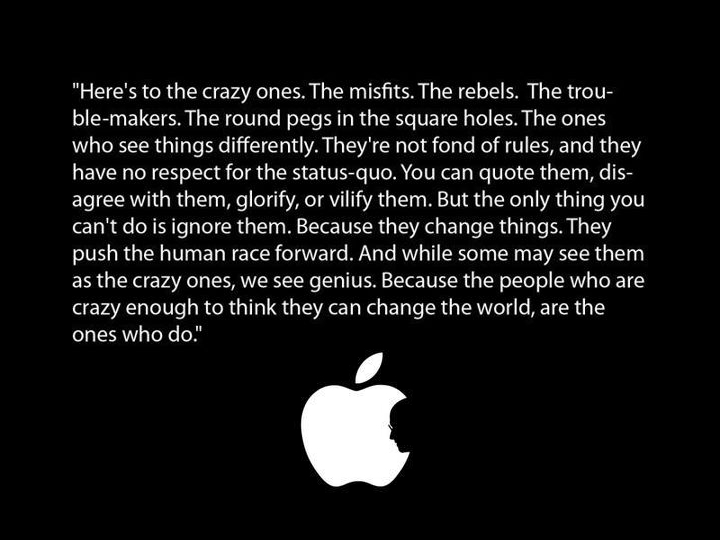
I am the starry-eyed optimist, the wild-haired crazy one who drinks way too much coffee, always saying "Trust me, it'll work," often wrong but not always. I'm not sure if you all have heard of Larry Ellison of Oracle or Elon Musk of SpaceX and Tesla. You know who Google is even if you've never heard of Larry Page. And hopefully, you've heard of Steve Jobs of Apple. This is one of the cool things Apple had to say about visionaries:
This league of extraordinary gentlemen (thought to be crazy by their contemporaries) sees a future of unbounded potential - exponential learning, sharing and information exchange that will make what's happened since the Dawning of the Internet look like a church house school room from The Little House on the Prairie. I'm only carrying their message . . . yes, possibly as a duped aficionado.
So, I'm not really going respond otherwise to the criticisms of using technology in the classrooms. Oh, I acknowledge them. I'm aware of them, not just theoretically but as one who is on the other side. I pioneer the use of technology in the classroom, at my own expense - financially & temporally - quite often. I've read the book Teachers & Machines by Larry Cuban, recommended by our good Doctor, as well as many other book-length criticisms of over-sold technology and the damage that the Information Age will cause our children. Some good one's include Howard Gardner's App Generation and Sherry Turkle's Alone Together. Very good reads all and understandably cautionary.
I am not a snake-oil huckster or corporate charlatan. I am someone who can see an unstoppable wave that is coming. Or, as economist Edward Castronova has called a "teacup in a hurricane" in his his cool-headed analysis of the future Exodus to the Virtual World. So, I choose to look forward to the bright Future not lament the unchangeable Past.
I will say this, as the most common observation (tech historians and tech advocates) of why seminal technology is not integrated, teachers are resisting technology in the classroom.
With all that said, I love the fun of the scholarly debate and philosophical discussions of whether or not we should do something simply because we can. And, if only for the fun of it, I'll always play the Devil's . . . I mean technology's advocate. And of course, the Borg were defeated, LOL!
Thanks for humoring a trusting, naive philosopher. Cheers!
Wednesday, November 2, 2016
Chalkboards & Sexy English
I'll take the first question as it will help folks to understand me better - as I feel I've misrepresented myself with my Virtual Zeal.
I began teaching English in suburban China in 2006.
Classrooms where as has existed since the first part of the Twentieth Century. The smartest part of the classrooms were the colored chalk - red, yellow & blue. I preferred to use white, though, as I general wore dress shirts to class. The combination of no air-conditioning & colored chalk, I discovered early on, led to a rainbow-tinted silt on my shoulders after four or five hours of black board scribbling & the concomitant erasures. Good times!
I loved using the chalk boards to elucidate language with Pictionary & Win, Lose or Draw vocabulary lessons. More good times. I didn't reach a school with a smartboard until my fourth year in China. And, I was resistant to change. I had no idea how to use a smart board. If someone asked, "Hey Bai Lao Shi . . . why no use computer?" I'd huskily retort, "All I need is a group of Chinese minds & a sexy subject to create English conversation."
And that is still very true.
I prefer to simply engage groups of English-as-a-Second Language (ESL) learners in Socratic Seminars. The topics are endless & I don't believe we'll ever need media to teach language. The media (our voices) & method (interesting inter-locution) that has existed for language learning these thousands of years is quite sufficient & necessary to create meaning.
I've only become an EdTech Strategist as I have found that it has far more appeal to youth. Appeal is not necessary for language learning. But, it enhances it greatly. As there are so many wonderful & appealing digital flash card apps (Quizlet), speech-to-text capabilities (Merriam-Webster powered by Google) & tablet top quizzing platforms (Socrative) . . . well, I'm a kid in a digital eye-candy store.
Digital media is not necessary to learn language, or anything else that was taught before the brilliant dawning of the Information Age. But it really is a good time. And I want to know & use every sexy novelty that comes along. After all, we are here for a good time, aren't we? Yes, I think I read that somewhere.
Thanks for your patience with my loony crooning about tech, ya'll.
Cheers,
Ry
Monday, October 31, 2016
On Good & Bad Design in Education
You all know my usual appeal.
I'll illustrate it here with groups of youth
- actively
- enthusiastically
- collaboratively
- project-minded
- involved in learning.
Good thoughtful insightful design.
Environments that more closely simulate performance context - their work place in the future.

And then, groups of youth, learners
- separated
- disconnected
- decontextualized
- test-minded
- passively submitting to education.


Not necessarily bad design, design for something other than learning - becoming "another brick in the wall," cogs in the machine of the industrial age.
Environments that simulate the workplace of the past.

Wednesday, October 19, 2016
Tuesday, October 18, 2016
A History of Instructional Design & Technology - Robert A. Reiser
Professor Robert A. Reiser summarizes "A History of Instructional Design & Technology" in this week's supplemental reading for our favorite class, Foundations of Instructional Design (truly!). I very much appreciated this summary by our good historian & it gives me great empathy for all technology integrators - past, present & future.
As a prelude (or really in depth analysis) to this summary, Dr. Monson recommended to me a fabulously descriptive book by Larry Cuban, Teachers & Machines: The Classroom Use of Technology Since 1920. I also recommend this book, & if anyone would like, they are certainly welcome to my copy - already annotated for quick scan.
I read a brilliant quote recently by Clay Shirky, a brilliant observer of technology integration, in Cathy Davidson's insightful book, Now You See It: How Technology and Brain Science Will Transform Schools and Business for the 21st Century.
"Institutions will try to preserve the problem for which they are the solution."
Clay Shirky
WOW! The meaning of that quote on me within the context of earning my ID stripes may not be readily available. So, I'll just let it sit there with you & marinate while I stew over Dr. Reiser's revelation.
What's really adorable about Reiser's survey of EdTech implementation is the warning he advocates in the first of his "Summary of Key Principles." When looking back over the acceptance & implementation of the progressive flow of media inventions Reiser observes:

Clearly, Reiser, among many others who are absolutely nothing like me, is adopting a conservative stance. Iornically, as society moves up the asymptotic vertical of the exponential technology curve he's looking backward & learning the lesson of not being so starry-eyed optimistic. It is our proximity to the bend in the technology curve that should be giving folks the the reasons to be more & more optimistic. A historian's view of history is necessarily linear. I do not expect people who study the past to understand the future & the holographic - not linear - nature of coming progress.
And notice that the consistent & concomitant reason for slow acceptance of a media or innovation is resistance by teachers. One wonders that if there'd never been any resistance in the first place if Edison would have actually been right. SO: teachers! Stop resisting! Leave those kids alone!
Also, if promoters had been less optimistic & more balanced in their view, would the adoption have been even less substantial?
Should they, like the critics, just have plopped down on the sidelines said, "Nope, this is gonna be just like every technology before it. You watch. It's not gonna have the wide acceptance that those googly-eyed, naive optimists think it will have."
Woah! That was a rant! Not really my style, but it was fun. Trying on my biting critic voice.
With all that said, I'm definitely gaining an understanding of the wall I'm facing & the precendented bullets with which administrators & resistant teachers will sharp-shoot me. Fair enough.
It's a good thing I'm such a charming & exuberant, and to mention tenacious, salesman!
Good, good stuff! Thank you Dr. Reiser & Larry Cuban!
As a prelude (or really in depth analysis) to this summary, Dr. Monson recommended to me a fabulously descriptive book by Larry Cuban, Teachers & Machines: The Classroom Use of Technology Since 1920. I also recommend this book, & if anyone would like, they are certainly welcome to my copy - already annotated for quick scan.
I read a brilliant quote recently by Clay Shirky, a brilliant observer of technology integration, in Cathy Davidson's insightful book, Now You See It: How Technology and Brain Science Will Transform Schools and Business for the 21st Century.
"Institutions will try to preserve the problem for which they are the solution."
Clay Shirky
WOW! The meaning of that quote on me within the context of earning my ID stripes may not be readily available. So, I'll just let it sit there with you & marinate while I stew over Dr. Reiser's revelation.
What's really adorable about Reiser's survey of EdTech implementation is the warning he advocates in the first of his "Summary of Key Principles." When looking back over the acceptance & implementation of the progressive flow of media inventions Reiser observes:

Clearly, Reiser, among many others who are absolutely nothing like me, is adopting a conservative stance. Iornically, as society moves up the asymptotic vertical of the exponential technology curve he's looking backward & learning the lesson of not being so starry-eyed optimistic. It is our proximity to the bend in the technology curve that should be giving folks the the reasons to be more & more optimistic. A historian's view of history is necessarily linear. I do not expect people who study the past to understand the future & the holographic - not linear - nature of coming progress.
And notice that the consistent & concomitant reason for slow acceptance of a media or innovation is resistance by teachers. One wonders that if there'd never been any resistance in the first place if Edison would have actually been right. SO: teachers! Stop resisting! Leave those kids alone!
Also, if promoters had been less optimistic & more balanced in their view, would the adoption have been even less substantial?
Should they, like the critics, just have plopped down on the sidelines said, "Nope, this is gonna be just like every technology before it. You watch. It's not gonna have the wide acceptance that those googly-eyed, naive optimists think it will have."
Woah! That was a rant! Not really my style, but it was fun. Trying on my biting critic voice.
With all that said, I'm definitely gaining an understanding of the wall I'm facing & the precendented bullets with which administrators & resistant teachers will sharp-shoot me. Fair enough.
It's a good thing I'm such a charming & exuberant, and to mention tenacious, salesman!
Good, good stuff! Thank you Dr. Reiser & Larry Cuban!
Tuesday, October 11, 2016
Monday, October 3, 2016
Behaviorism vs. Cognitivism vs. Constructivism - Where the Rubber Meets the Road
This week's reading wiki is based on Dr. Peg Ertmer's contrast/comparison of three major learning theories: Behaviorism, Cognitivism & Constructivism - a veritable "where the rubber meets the road." I like this "engineering analogy" as a metaphor
And now - I shall used Google's brilliant speech-to-text engine in a metacognitive, EdTech application:
Historical Foundations
Woah, that was a messy one & I really think that either Google's got bad ears or I'm slurring my speech at this late hour.
And just for good measure, I'll attach the PDF
 |
| https://iappd.net/wp-content/uploads/2008/09/when-rubber-meets-the-road.jpg |
And now - I shall used Google's brilliant speech-to-text engine in a metacognitive, EdTech application:
Linking science - middleman position - engineering analogy = and Aid for translating Theory into practice
Translate relevant aspects of the learning theories into optimal instructional actions
Instructional designers charged with translating principles of learning and instruction into specifications for instructional materials and activities
What are the situational and contextual constraints of the application?
What is the degree of individual differences among the Learners?
What form of solutions will or will not be accepted by the Learners as well as by those actually teaching the materials?
Learning theories are a source of verified instructional strategies, tactics and techniques.
Learning series provide the foundation for intelligent reasons strategy selection.
Integration of the selected strategy within the instructional context is of critical importance.
***The ultimate role of a theory is to allow for Reliable prediction.
Each Theory still describes the same phenomena - learning.
Understanding of the theories can provide you with a canny strategy whereby you could know a great deal about a lot of things will keeping very little in mind.
Learning is an enduring change in Behavior, or in the capacity to behave in a given fashion, what results from practice or other forms of experience.
Definitive questions that serve to distinguish each learning theory
How does learning occurs?
Which factors influence learning?
What is the role of memory?
How does transfer occur?
What types of learning are best explained by the theory?
What basic assumptions / principles of this theory are relevant to instructional design?
How should instruction be structured to facilitate learning?
Historical Foundations
Where does knowledge come from and how do people come to know it?
Empiricism and rationalism
Empiricism - experience is the primary source of knowledge
organisms are born with basically no knowledge and anything learned his game through interactions and associations with the environment
Aristotle
Knowledge is derived from sensory Impressions
when Associated continuously and time and/or space can be hooked together to form complex ideas
Manipulate the environment in order to improve and ensure the occurrence of proper associations
Rationalism
Knowledge derives from reason without the aid of the senses
Plato
Humans learn by recalling or discovering what already exists in the mind
A reflection on one's ideas
Knowledge arises through the Mind
Behaviorism
 |
| http://www.forwardwalking.com/2013/03/28/the-wagon-wheel-of-life/ |
Cognitivism
 |
| http://www.speedwaymotors.com/Article/Article?keyId=28813 |
Constructivism
 |
| https://www.netcarshow.com/citroen/2016-cxperience_concept/ |
Woah, that was a messy one & I really think that either Google's got bad ears or I'm slurring my speech at this late hour.
Spent most of my Foundations of Instructional Design studytime budget this weekend on a Nearpod presentation for the article by Dr. Ertmer.
I'll embed it below (here's a link, well: Theories Meet the Instructional Road
And just for good measure, I'll attach the PDF
Saturday, October 1, 2016
Must-see Advance Organizers Explanation
Wow! Check out this explanation of Advance organizers.
Thank you so much study.com!
Study.com Advance Organizers
Thank you so much study.com!
Study.com Advance Organizers

Thursday, September 29, 2016
Wednesday, September 28, 2016
Sunday, September 25, 2016
Analysis of Target Market . . . er, Population
What are the descriptors of our target market . . . target population?
While reading this week's chapter, & now seeing the Matrix of ADDIE a little more clearly, I highlighted, copied & pasted the issues that I thought would be most significant to our team's (3 J's & an R) Big Project. These are pulled right from the text of The Systematic Design of Instruction - Dick & Carey - so credit where it's due.
Thank you oh great Dick & Carey . . . we bask in your generous brilliance! Sincerely.
While reading this week's chapter, & now seeing the Matrix of ADDIE a little more clearly, I highlighted, copied & pasted the issues that I thought would be most significant to our team's (3 J's & an R) Big Project. These are pulled right from the text of The Systematic Design of Instruction - Dick & Carey - so credit where it's due.
Thank you oh great Dick & Carey . . . we bask in your generous brilliance! Sincerely.
Issues very relevant to our target population:
- Tryout learners serve as representatives of that group in order to plan the instruction.
- ARCS model (attention, relevance, confidence, and satisfaction)
- Do not assume that learners are very interested in the topic, find it relevant to their interests or job, feel confident that they can learn it, and will be satisfied when they do.
- Added problem associated with this project, namely recruiting [teachers/administor] support.
- Training in new instructional software is irrelevant for teachers who have severely outdated computers in their classrooms that won’t run current software applications.
- Does the learning environment that you are visiting include these tools? Can it accommodate them if they are provided? The most common “tools” today are probably computers and smart mobile devices.
- Sometimes just the act of explaining the analysis leads to insights about duplications, omissions, unclear relationships, illogical sequences, or unneeded information.
- You must see how a learner from the target population reacts to the skills you will be teaching.
- Does the learner understand what you are talking about? How would the learner describe it in his or her own words? Can the learner perform the entry skills?

Sweet! I'm learning the ADDIE lingo!
Learning the Language of ADDIE
Lingo instruca, anyone?
One of the things that I just began to appreciate this weekend was the repetition of terms. Perhaps I am just thick-headed or stubborn but many of these new terms associated with analysis & ADDIE felt irritatingly similar & sometimes redundant.
I think it's beginning to sink in, finally, & the true significance of subtle difference between things like goal statement & instructional need is starting to make sense to me.
It was easier for me to think of it all as an analysis problem for which their must be an app or at least some software (like MindMeister) for which I could simply plug in the characteristics of my idea - making teaching, learning & consuming information easier through VR - in over-simplistic terms & my potential target population. Then, the app's algorithm would simply spit out the analyses & I could move forward from their to design & development (production) of the process for which I could apply my solution.
In a very cool & real way, the continual introduction & repetition of these terms by different authors is like learning a new language. Like learning Arabic, much of the first few weeks & chapters The Systematic Design of Instruction - Dick & Carey was so much incoherent psycho-babble to me.
Now, & this is a little scary, it is starting to become more fluid in my mind & I feel a little like Neo - I'm starting to see the vocabulary & definitions of surrounding the real-world process like Neo sees the code precipitating in eerie green columns through the Matrix. I'm believing & thinking & dreaming in ADDIE!
SWEET!!!
Guess I'd better not get cocky - I can hear Han Solo chiding me for nailing my first Imperial Tie Fighter & over-celebrating.
I'm not giving up that eventually there'll be strong AI that'll listen to my dictation of the problem & spit out the analyses based on the big data available to such an Eschelon/Eagle-Eye/Skynet supercomputer.
With that said, I am starting to become very interested in the analysis process. So much so, that I am eager to get surrounded by teachers who are afraid of implementing tech in class & do a lot of interviews & surveys.
Guess I'll go make a Survey Monkey!
Lingo instruca, anyone?
One of the things that I just began to appreciate this weekend was the repetition of terms. Perhaps I am just thick-headed or stubborn but many of these new terms associated with analysis & ADDIE felt irritatingly similar & sometimes redundant.
I think it's beginning to sink in, finally, & the true significance of subtle difference between things like goal statement & instructional need is starting to make sense to me.
It was easier for me to think of it all as an analysis problem for which their must be an app or at least some software (like MindMeister) for which I could simply plug in the characteristics of my idea - making teaching, learning & consuming information easier through VR - in over-simplistic terms & my potential target population. Then, the app's algorithm would simply spit out the analyses & I could move forward from their to design & development (production) of the process for which I could apply my solution.
 |
In a very cool & real way, the continual introduction & repetition of these terms by different authors is like learning a new language. Like learning Arabic, much of the first few weeks & chapters The Systematic Design of Instruction - Dick & Carey was so much incoherent psycho-babble to me.
 |
| comicvine.gamespot.com |
SWEET!!!
Guess I'd better not get cocky - I can hear Han Solo chiding me for nailing my first Imperial Tie Fighter & over-celebrating.
I'm not giving up that eventually there'll be strong AI that'll listen to my dictation of the problem & spit out the analyses based on the big data available to such an Eschelon/Eagle-Eye/Skynet supercomputer.
With that said, I am starting to become very interested in the analysis process. So much so, that I am eager to get surrounded by teachers who are afraid of implementing tech in class & do a lot of interviews & surveys.
Guess I'll go make a Survey Monkey!
Saturday, September 24, 2016
Characteristics of ID Models - Branch & Merrill
I really enjoyed this week's reading assignment for Instructional Design.
I felt that it was a prose version of the Wiki that is needed to understand in a very straightforward way, the models of ID.
So, I will translate it into week sitebites:
I felt that it was a prose version of the Wiki that is needed to understand in a very straightforward way, the models of ID.
So, I will translate it into week sitebites:
Characteristics of Instructional Design Models - Robert M. Branch & M. David Merrill
Instructional Design (ID) - system of procedures for developing Education and Training curricula in a consistent and reliable fashion
General Systems Theory (GST) - approach to accomplishing learning test since of instructional problems - based on behaviorism values associated with measurement and study of human behavior (Silvern);
Instructional Design (ID) - system of procedures for developing Education and Training curricula in a consistent and reliable fashion
General Systems Theory (GST) - approach to accomplishing learning test since of instructional problems - based on behaviorism values associated with measurement and study of human behavior (Silvern);
- Systematic - adopt rules/procedures; way to move through process
- Systemic - application of creative problem-solving methods; all components of system respond to single component w/in system as stimulated
- Responsive - accepting whatever goals established as its orientation
- Interdependence - all elements w/in system connected to every other element; all elements depend on each other to accomplish system's goals
- Redundancy - duplicate processes/procedures intended to prevent failure of the entire system
- Dynamic - adjust to changing conditions, constantly monitors environment
- Cybernetic - efficiently communicate among themselves for the purpose to steer, govern & guide; automated control systems
- Synergistic - together all elements achieve more than individual elements achieve alone; "the whole is greater than the sum of its parts"
- Creativity - special human talents/imagination & generating original ideas to permit instructional designers to expand the limitations of any system
Actual practice of ID - curvilinear flow diagram; curvilinear compositions of ovals connected by curved lines with 2-way arrows; communicate more iterations
ADDIE
- Analyze - needs assessment; identifying a performance problem in a business setting; stating a goal; writing objectives & measurable terms; classifying learning as to type; specifying learning activities; specifying media
- Design/development - preparing student/instructor materials
- Implementation - delivering instruction in setting for which it was designed
- Evaluation
- Formative - collecting data to identify needed revisions to the instruction
- Summative - collecting data to assess the overall effectiveness and worth of instruction
- Revision - making needed changes
- Student-centered - teaching & other forms of instruction or simple means to the end of learner performance; no initial assumption live teachers even needed
- Goal oriented - goals should reflect client expectations; team members need to share a common vision
- Meaningful performance - preparing learners to perform meaningful/complex behaviors; high degree of congruence between learning environment & setting in which the actual behaviors performed
- Outcomes measurable, reliably/validly - assessment technique within an observer/checklist while the learner performs selected operations
- Empirical, iterative & self-correcting - data at heart of ID process; data are friendly & provide a rational basis for decision-making & successfully project completion
- Team effort
- Subject matter expert (SME)
- Instructional designer
- Production personnel
- Clerical support
- Project manager
- Learners should be presented with a series of progressively more difficult tasks problems of the type that the learners will be expected to solve by the end of that instruction sequence
 |
| Dick & Carey ID model; 12. Merrill: Pebble in the Pond |
Friday, September 23, 2016
Grant Bushman's Sally Experience
Grant Bushman
"Sally" was put in my class because she was a smart girl who was having a terrible time with reading fast enough. She just didn't seem to understanding how to do it. The red line indicates where a 2nd grader should be at over time. Students at or above the red line are considered "on benchmark." And Sally was clearly below benchmark. Her parents were concerned, her past teacher was out of ideas, and the principal thought I could help her.
As time went on, I used by very best tricks to help Sally get motivated. She got motivated. I modeled the benefits of a strong work ethic. She worked hard. I showed her the joys of reading. She wouldn't stop reading at home. Then, after Christmas break, I gave her yet another reading assessment. She was making progress, but not the kind of progress that he parents wanted, and not the kind of progress that would get her on level by the end of the year. I just couldn't find the missing piece.
Then, on February 10, a miracle occurred. Was it the excitement of the impending Valentines Day party? Was it the melting snow? Was it a new research-based reading program? Was it her new ADHD meds? Nope. It was a 30-second intervention. After 30-seconds, Sally's words per minute nearly doubled. She maintained that jumped for the rest of the year. She never dropped below benchmark again, and she finished the year in seventh place among her classmates. 30-seconds made all the difference.
The Twin Sins
But enough about me. Let's talk about a different Grant for a while. In Understanding By Design, author Grant Wiggins describes the Twin Sins of Design. They are "Coverage" and "Activity." Coverage is the boring history teacher who destroys your will to live by spouting names and dates at a blistering speed because the content must be "covered." Activity is the enthusiastic kindergarten teacher who spends four days making marmalade in mugs to help her student love the letter m. The kids are involved and engaged--but do they know what an M looks like yet?
The Backward Design Model
To guard against these twin sins, Wiggins introduces the Backward Design Model. That is, a teacher begins by first asking, "What am I trying to accomplish here?" The worksheets, visual aids, and anecdotes come later.
Although the Backward Design Model follows a very logic, step-wise method, Wiggins admits that the process is actually quite messy, and doesn't always fit the prescribe model chronologically. Regardless of when the steps happen, here is their conceptual progression.
Wiggins quotes author Stephen Covey's principle of effectiveness, "Begin with the end in mind." Simple reason suggests that a person is more inclined to end up at a desired destination if one knows the destination to which one should travel. By focusing on outcomes first, an instructor is better able to design and develop an educational experience that will yield those outcomes.
The Wrap-Up
This was my secret with Sally. On February 10, I whispered to Sally. "I want to see how fast you can read. I don't care what you learn. I don't care if you use good expression. I don't care if you mess up a few words. I want to see you fly through this." Once Sally knew how to "win" the game of reading, she did. I can't believe it took me six months to realize that I hadn't taught her the one things she needed most.
How embarrassing.
Okay, you're turn. What is your Sally experience? How would the Backward Design Model have prevented it from happening?
Hey Grant,
That is just a brilliant story. Well told, as well. Thanks for sharing.
Winning the game & gamifying classwork has been a favorite of mine for years. When a student (or anyone) views their goal as more of a game-oriented process the thing becomes fun. Then the individual really takes ownership of it - like Sally did.
Line graphs are brilliant as well. Did you show Sally her progress on the graph? There's a very cool speed reading program called EyeQ (Links to an external site.). I've used it to help some of my students improve their reading speed (as well as my own). It's doubled & even tripled reading speeds - to over 200 words for one prodigious kiddo. It's gamified & users score badges for progress & can see their progress going up & down on a graph - very strong motivation.
I enjoy Wiggins articulation of a logical process of curriculum design. I feel it is very intuitive, really just the way that I think about problem-solving. It's very nice to have it written out in an elegant template.
With that said, I'm not sure that the Backward Design Model would have led you any faster to your genius stroke of coaching motivation. In fact, I think analysis of the speed reading situation, based on Wiggins model, might have led to academic paralysis & frustration. Your spurring Sally into an inspirational second wind was more of a spontaneous light-bulb thing which we are occasionally grateful to be given.
Does that make sense?
At any rate, Bravo, my good Man! Keep up that #1 2nd Grade Teacher status!
"Sally" was put in my class because she was a smart girl who was having a terrible time with reading fast enough. She just didn't seem to understanding how to do it. The red line indicates where a 2nd grader should be at over time. Students at or above the red line are considered "on benchmark." And Sally was clearly below benchmark. Her parents were concerned, her past teacher was out of ideas, and the principal thought I could help her.
As time went on, I used by very best tricks to help Sally get motivated. She got motivated. I modeled the benefits of a strong work ethic. She worked hard. I showed her the joys of reading. She wouldn't stop reading at home. Then, after Christmas break, I gave her yet another reading assessment. She was making progress, but not the kind of progress that he parents wanted, and not the kind of progress that would get her on level by the end of the year. I just couldn't find the missing piece.
Then, on February 10, a miracle occurred. Was it the excitement of the impending Valentines Day party? Was it the melting snow? Was it a new research-based reading program? Was it her new ADHD meds? Nope. It was a 30-second intervention. After 30-seconds, Sally's words per minute nearly doubled. She maintained that jumped for the rest of the year. She never dropped below benchmark again, and she finished the year in seventh place among her classmates. 30-seconds made all the difference.
The Twin Sins
But enough about me. Let's talk about a different Grant for a while. In Understanding By Design, author Grant Wiggins describes the Twin Sins of Design. They are "Coverage" and "Activity." Coverage is the boring history teacher who destroys your will to live by spouting names and dates at a blistering speed because the content must be "covered." Activity is the enthusiastic kindergarten teacher who spends four days making marmalade in mugs to help her student love the letter m. The kids are involved and engaged--but do they know what an M looks like yet?
The Backward Design Model
To guard against these twin sins, Wiggins introduces the Backward Design Model. That is, a teacher begins by first asking, "What am I trying to accomplish here?" The worksheets, visual aids, and anecdotes come later.
Although the Backward Design Model follows a very logic, step-wise method, Wiggins admits that the process is actually quite messy, and doesn't always fit the prescribe model chronologically. Regardless of when the steps happen, here is their conceptual progression.
- Identify the Desired Result – What’s the point of what I am teaching? Examples might include "Student will read with sufficient fluency to support comprehension of text." or "Students will gain appreciate for the work of Martin Luther King, Jr."
- Determine Acceptable Evidence – What counts as mastered? Examples might include "Sally will read at a rate of 87 words per minute with 99% accuracy." or "Students will be able to assemble a scrapbook of artifacts Dr. King's rallies and explain how the artifact represents the events that took place at the rally."
- Plan Learning Experiences and Instruction – What will I actually do to bring about learning? Examples include "Teach lesson 48-53 in the Saxon Phonics book, omitting questions that don't relate to digraphs and diphthongs." or "Have each student find a speech given by Rev. King and present it to the class."
Wiggins quotes author Stephen Covey's principle of effectiveness, "Begin with the end in mind." Simple reason suggests that a person is more inclined to end up at a desired destination if one knows the destination to which one should travel. By focusing on outcomes first, an instructor is better able to design and develop an educational experience that will yield those outcomes.
The Wrap-Up
This was my secret with Sally. On February 10, I whispered to Sally. "I want to see how fast you can read. I don't care what you learn. I don't care if you use good expression. I don't care if you mess up a few words. I want to see you fly through this." Once Sally knew how to "win" the game of reading, she did. I can't believe it took me six months to realize that I hadn't taught her the one things she needed most.
How embarrassing.
Okay, you're turn. What is your Sally experience? How would the Backward Design Model have prevented it from happening?
Hey Grant,
That is just a brilliant story. Well told, as well. Thanks for sharing.
Winning the game & gamifying classwork has been a favorite of mine for years. When a student (or anyone) views their goal as more of a game-oriented process the thing becomes fun. Then the individual really takes ownership of it - like Sally did.
Line graphs are brilliant as well. Did you show Sally her progress on the graph? There's a very cool speed reading program called EyeQ (Links to an external site.). I've used it to help some of my students improve their reading speed (as well as my own). It's doubled & even tripled reading speeds - to over 200 words for one prodigious kiddo. It's gamified & users score badges for progress & can see their progress going up & down on a graph - very strong motivation.
I enjoy Wiggins articulation of a logical process of curriculum design. I feel it is very intuitive, really just the way that I think about problem-solving. It's very nice to have it written out in an elegant template.
With that said, I'm not sure that the Backward Design Model would have led you any faster to your genius stroke of coaching motivation. In fact, I think analysis of the speed reading situation, based on Wiggins model, might have led to academic paralysis & frustration. Your spurring Sally into an inspirational second wind was more of a spontaneous light-bulb thing which we are occasionally grateful to be given.
Does that make sense?
At any rate, Bravo, my good Man! Keep up that #1 2nd Grade Teacher status!
Varieties of Human Capabilities - Schiffman
Hey Colleagues & fellow education scientists,
Sorry I missed you guys last week - I was so eager to show off my skills as a VR trainer. Also, I can bring the Gear Headset & it's Oculus store anytime. I'd love for you guys to experience what is available on these devices & platforms. We played with the Gear at John's Youth City & we had to pry the kids away from their transformative experiences. Virtual & augmented reality are going to become far cheaper & much more mainstream within the next 12 months - especially as Google is going to release it's VR platform via Daydream, any day now.
Last week in the Schiffman selection, there was a section titled "Varieties of Human Capabilities." I imagine I wasn't the only one that wrote a big red question mark, followed by several exclamation points in the margin. Schiffman, who I believe is on the side of humanism & the teacher - as opposed to the shrill critics or anti-tech academics - . . . Schiffman writes that a knowledge of human capabilities supplies an instructional designer with certainty about what the instructional system needs. Below this, he writes,
"Training journals complain that classroom instruction does not transfer to on-the-job competence." (p 138)
Did you folks have a field day with that? I know it was written in 1995 & things have changed a lot since then. Who would have a better awareness of human capabilities - students are humans, right? - than a classroom instructor?!
Did you guys discuss that in class? Any commentary on that one?
Here's a sample of my on the job training:
Thanks,
Ry
Sorry I missed you guys last week - I was so eager to show off my skills as a VR trainer. Also, I can bring the Gear Headset & it's Oculus store anytime. I'd love for you guys to experience what is available on these devices & platforms. We played with the Gear at John's Youth City & we had to pry the kids away from their transformative experiences. Virtual & augmented reality are going to become far cheaper & much more mainstream within the next 12 months - especially as Google is going to release it's VR platform via Daydream, any day now.
Last week in the Schiffman selection, there was a section titled "Varieties of Human Capabilities." I imagine I wasn't the only one that wrote a big red question mark, followed by several exclamation points in the margin. Schiffman, who I believe is on the side of humanism & the teacher - as opposed to the shrill critics or anti-tech academics - . . . Schiffman writes that a knowledge of human capabilities supplies an instructional designer with certainty about what the instructional system needs. Below this, he writes,
"Training journals complain that classroom instruction does not transfer to on-the-job competence." (p 138)
Did you folks have a field day with that? I know it was written in 1995 & things have changed a lot since then. Who would have a better awareness of human capabilities - students are humans, right? - than a classroom instructor?!
Did you guys discuss that in class? Any commentary on that one?
Here's a sample of my on the job training:
Thanks,
Ry
Inspiration - Self Organized Learning Environments (SOLEs)
"Learning can emerge as spontaneous order at the edge of chaos."
- Sugata Mitra - Professor of EdTech, Newcastle University
Winner TED Prize 2013
"There's a difference between knowing the path & walking the path."teachbytes - 10 Educational Technology Quotes
Technology is the use of artificial tools to make human life easier, more efficient/effective & more fun. It must have "appeal" - Dr. Monson. And it must supervene earlier technology in order for it to fit the former definition. Otherwise, it's simple a flashy new tool.
The Future of Learning - CUE Palm Springs 2016
Most Likely To Succeed-Film - John Lyman Post
Most Likely To Succeed-Film
John Lyman
Most Likely to Succeed
Screening in conjunction with the Utah Afterschool Network's Annual Jumpstart Conference:
10/07/16 Ogden, UT Peery's Egyptian Theater, 2415 Washington Boulevard at 7:00 PM
http://www.mltsfilm.org/ (Links to an external site.)
--------------------------------
Has anyone seen this? It seems like it should be mandatory for our discipline.
--My commentary
Sep 2, 2016
John Lyman
Most Likely to Succeed
Screening in conjunction with the Utah Afterschool Network's Annual Jumpstart Conference:
10/07/16 Ogden, UT Peery's Egyptian Theater, 2415 Washington Boulevard at 7:00 PM
http://www.mltsfilm.org/ (Links to an external site.)
--------------------------------
Has anyone seen this? It seems like it should be mandatory for our discipline.
--My commentary
Sep 2, 2016




Subscribe to:
Posts (Atom)